




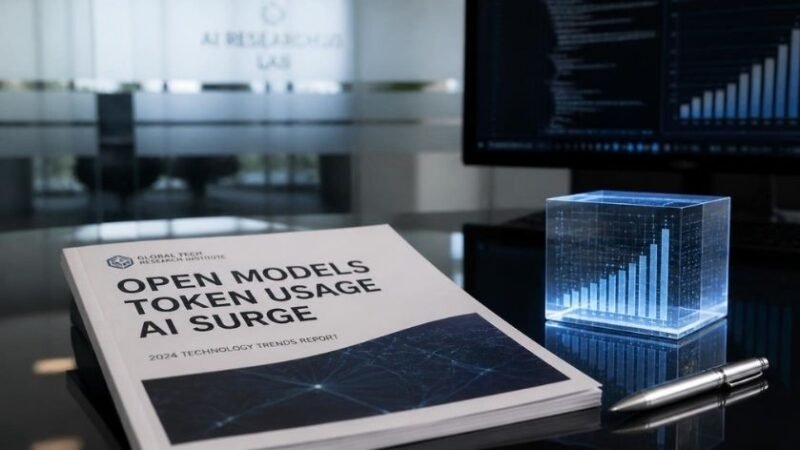
A striking shift is taking place in how organisations consume AI. According to Vercel CEO Guillermo Rauch, open-weight models grew from 28.4 percent to 62 percent of token usage on Vercel’s AI Gateway between June and August. He described August 22 as a record day. In just a few months, open-weight models went from a minority share to the majority of tokens on this platform.
Rauch expects the trend to continue. In his view, enterprise adoption is still early, and most tooling is not yet model-agnostic. That suggests many organisations have not yet had the chance to switch models easily, and that the shift may accelerate as tooling matures. For you, it is a signal that your current model choice may not be the one you use a year from now.
Cost appears to be a central driver. According to figures cited by Chamath, one million tokens costs roughly $26 from OpenAI and $56 from Anthropic. The same volume costs about $1 from xAI, $1.50 from Meta and $0.50 from Chinese providers. The gap is large enough to influence budgets and vendor decisions.
These numbers also point to a business risk. Enterprises betting on the pricier closed models may find it difficult to pass those costs on to customers as cheaper alternatives close the quality gap. If competitors deliver similar results at a fraction of the price, margins come under pressure. A community comment on the story framed the move as a straightforward cost-driven business decision rather than a surprise.
Open-weight does not automatically mean unrestricted. Downloadable weights do not guarantee that you can use a model freely in a commercial setting. Kimi K3 and MiniMax M3 require revenue-based licensing agreements, while DeepSeek V4 and GLM 5.2 use permissive MIT licenses. Each model therefore needs its own check before you deploy it.
The practical advice is to read the licensing terms before assuming you can deploy a model freely, and to compare token pricing across providers before locking a team into a single vendor. Building on tooling that is not tied to one model can also keep your options open. Treat model selection as an ongoing governance and risk decision, not a one-time technical choice.
Read daily.dev article for more information.