



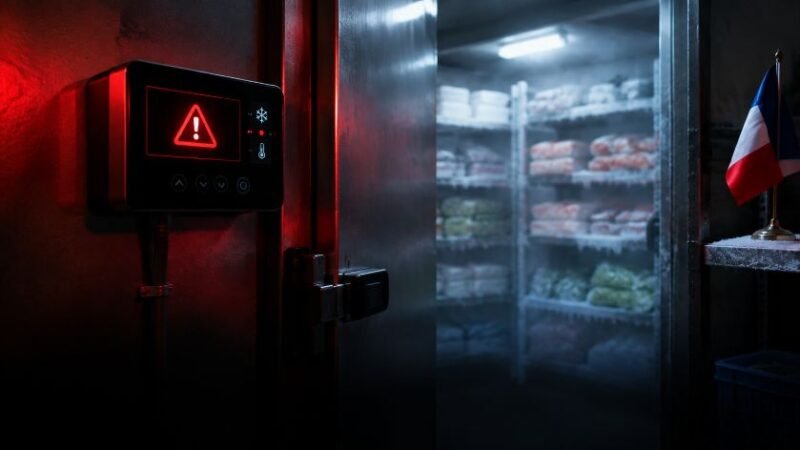
The Danfoss cyber attack waves that began in France on October 11 have hit internet-exposed fridge controllers from Danfoss and Copeland across Europe. Attackers triggered defrosting, which caused tens of millions of euros in spoilt food and, in some cases, fires. SentinelOne warns that attribution remains open and that not every incident should be linked to the same threat actor.
According to Midnight Blue, the impact contrasts sharply with the technical simplicity of these fridge controller cyber attacks. Researcher Carlo Meijer found six pre-authentication remote code execution zero-day vulnerabilities in Danfoss AK-SM 800A firmware version 5.3.2, in less than an hour. Pre-authentication means an attacker needs no login. A zero-day is a flaw without a vendor fix. Details are withheld while coordinated disclosure with Danfoss continues.
Midnight Blue points to weak security basics in the Danfoss AK-SM 800A vulnerability findings. The main application uses hundreds of strcpy calls, a function that copies data without checking its size, in unauthenticated handlers. Stack canaries and PIE, two standard memory protections, are not enabled. Several Danfoss business units hold IEC 62443-4-1 certification, yet Midnight Blue says such certificates reveal little about real product security.
Exposure remains high. According to Censys, hundreds of Danfoss systems and over 1,000 Copeland and Dixell controllers are still online. The first public proof-of-concept exploits appeared within 48 hours of the French attacks, before the second wave on November 2.
Midnight Blue says changing default credentials and applying patches is insufficient. Asset owners should remove internet exposure with a VPN, a private APN or highly restrictive IP whitelisting. Scarce security resources are better spent on reducing exposure than on patching.
Read midnightblue.nl article for more information.